 Skip to main content
Marquise Cut Diamond Guide: Ratio, Clarity & Shape
Marquise Cut Diamond Guide: Ratio, Clarity, Cost, and How to Buy One Right
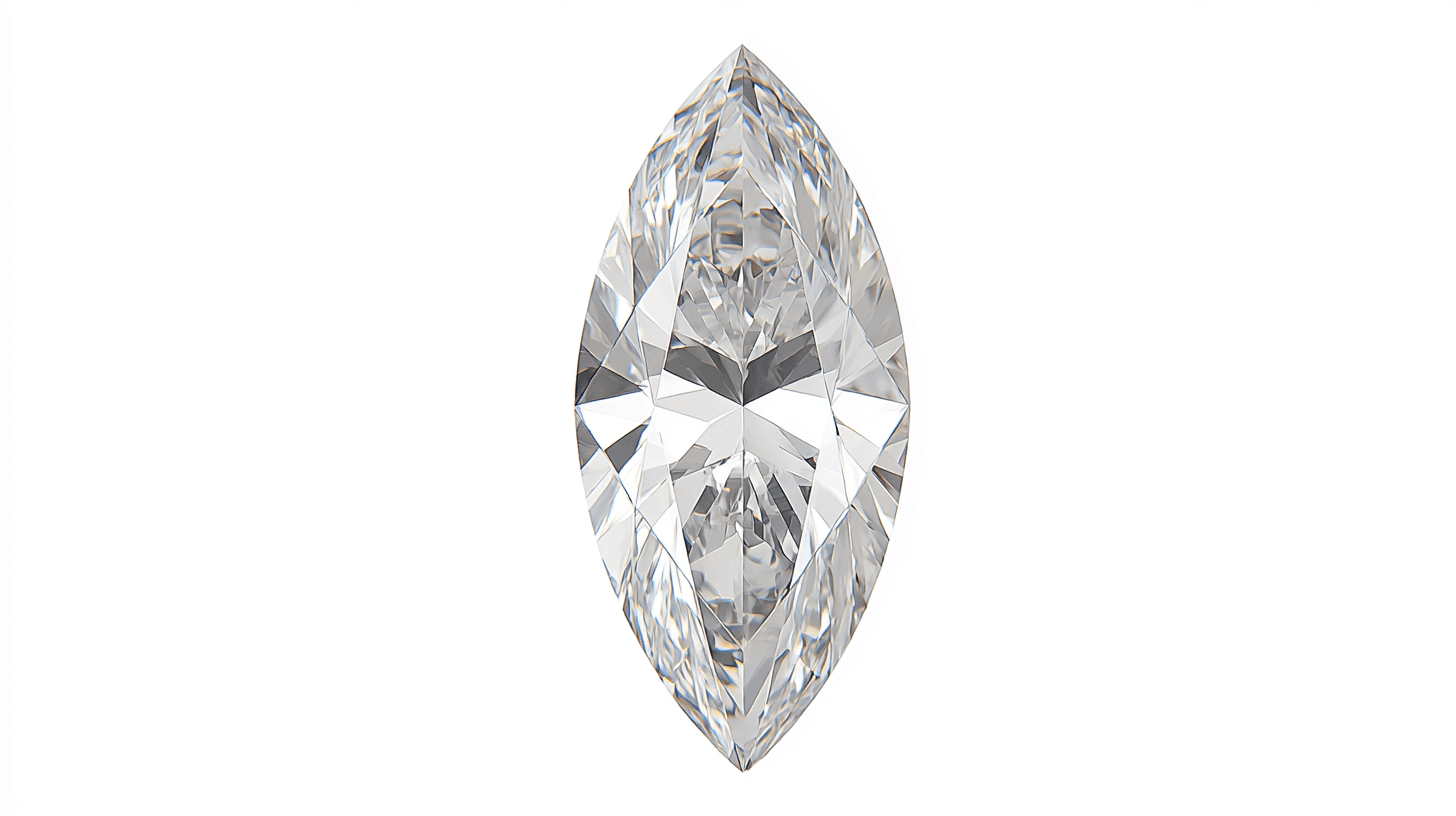
A marquise cut diamond is an elongated brilliant-cut stone with a curved body and two pointed ends, also called a navette. It has the largest face-up surface area per carat of any diamond shape, looks roughly 32% bigger than a round diamond of equal weight. It's the shape to choose if maximum visual size per dollar is the goal.
Key takeaways:
Best length-to-width ratio: 1.75–2.00 for the classic, balanced marquise look
Clarity sweet spot: VS2 or SI1 — but check the points specifically, not just the center
Color sweet spot: G–I — slightly wider tolerance than other elongated shapes
What Is a Marquise Cut Diamond?
A marquise cut diamond is a fancy-shape stone with a curved, boat-like outline that comes to a sharp point at each end. The name comes from the French navette, meaning "little ship," and the shape has carried aristocratic associations since the 18th century, when it was worn by prestigious European nobility as a mark of rank.
The marquise is a brilliant-cut style, typically carrying 56 to 60 facets depending on how the pavilion is arranged. Unlike step cuts, which use large, flat facets for a "hall of mirrors" look, the marquise's brilliant faceting scatters light for maximum fire and scintillation across its long body.
Four anatomical parts matter when evaluating a marquise diamond:
Belly:
the widest point of the stone, where width is measured
Wing:
the curved section running from the belly to each point
Point:
where the two curved sides meet at either end
Keel line:
the ridge along the bottom of the stone where the pavilion facets converge
Because the shape isn't standardized like a round brilliant, GIA does not assign marquise diamonds an overall cut grade — buyers have to judge proportions, symmetry, and light performance directly rather than relying on a single number.
Marquise Diamond Length-to-Width Ratio: What's Best?
L/W Ratio | Look | Best For |
1.55–1.74 | Broader, fuller body | Buyers who want marquise drama with a less extreme silhouette |
1.75–2.00 | Classic, balanced marquise | The most popular range — graceful without being fragile-looking |
2.01–2.20 | Long, slender, dramatic | Maximum elongation effect on the finger, more pronounced bow-tie risk |
There's no fixed "correct" ratio — it's a styling decision. Most buyers gravitate toward 1.75–2.00 because it holds the classic marquise silhouette without pushing the points so far apart that the stone looks fragile or the bow-tie effect becomes distracting.

Best Clarity Grade for a Marquise Cut Diamond
VS2 or SI1 is the practical sweet spot for a marquise, same as most elongated shapes — but where you look for inclusions is different. In a marquise, inclusions tend to concentrate near the points rather than the center, which is the opposite pattern from a shape like oval or emerald.
That matters for two reasons. First, the points are the most fragile part of the stone structurally, so an inclusion there can be both a visibility issue and a durability concern. Second, a well-cut marquise with clean points but a slightly included belly will often look cleaner face-up than a diamond with the same grade but the inclusion sitting near a tip.
Practical rule: at VS2/SI1, ask specifically about clarity near the points before buying, not just the overall grade.
Best Color Grade for a Marquise Cut Diamond
G–I color is the target range for most marquise diamonds — slightly wider tolerance than shapes like oval, which typically top out recommendations at H. Marquise diamonds can show color concentration at the points due to the elongated, narrow shape, but the effect is often masked well by prong settings at the tips.
G–H gives a bright, near-colorless look for buyers prioritizing whiteness. I color still reads clean to the naked eye for most buyers, especially set in yellow or rose gold, and represents meaningfully better value per carat.
How to Avoid (or Minimize) the Bow-Tie Effect
Like every elongated brilliant cut, marquise diamonds show some degree of bow-tie effect — a shadow across the center of the stone caused by the viewer's own head and shoulders blocking light. It's unavoidable in principle; the goal is minimizing how dark and blocky it looks.
Request a video, not a static photo.
The bow-tie shifts as the stone rotates; a photo can make a subtle shadow look worse than it is in person.
Confirm point alignment.
Both points should sit exactly on the stone's central axis — misaligned points read as crooked and often correlate with a heavier bow-tie.
Check wing symmetry.
The two curved sides should mirror each other; asymmetric wings distort both the shape and the light pattern.
Avoid extreme ratios above 2.00
unless you've specifically confirmed the bow-tie is light in that individual stone — longer, narrower marquise cuts show it more often.
Marquise vs. Oval vs. Round: How They Compare
Factor | Marquise | Oval | Round |
Facet style | Brilliant, pointed ends | Brilliant, no points | Brilliant |
Face-up area (1 ct, approx.) | ~43.7 mm² | ~40 mm² | ~33.2 mm² |
Apparent size advantage | Largest per carat of any shape | 5–10% larger than round | Baseline |
Price per carat | 20–30% less than round | 20–30% less than round | Highest |
Durability | Points need V-prong protection | Rounded, low chip risk | Lowest chip risk |
GIA cut grade | Not assigned (fancy shape) | Not assigned (fancy shape) | Assigned |
The marquise's edge over other elongated shapes comes down to raw face-up spread: a 1-carat marquise covers meaningfully more visible surface than a 1-carat oval or round, which is why it's the go-to shape for buyers trying to maximize apparent size on a fixed carat budget.
Marquise Diamond Engagement Ring Settings
The points are the structural weak spot of a marquise, so setting choice is a durability decision as much as a style one.
V-prong solitaire:
The classic marquise setting — V-shaped prongs cradle each point directly, the most secure standard option
Bezel:
Full metal rim encircles the stone, maximum point protection, modern look
Halo:
Smaller diamonds surround the center stone, adds brilliance and visually reinforces the outline
Three-stone:
Marquise center with smaller side stones, softens the sharp points visually while adding width
A poorly protected point on a marquise is a real risk in day-to-day wear — always confirm the setting uses V-prongs or a bezel at both tips, not standard rounded prongs.
Frequently Asked Questions
What is the best length-to-width ratio for a marquise diamond?
Most buyers land between 1.75 and 2.00. Ratios closer to 1.55 look broader and fuller; ratios above 2.00 look longer and more dramatic but carry a higher chance of a noticeable bow-tie effect. It comes down to personal taste in silhouette.
Why do marquise diamonds have a bow-tie effect?
The bow-tie is a shadow cast by the viewer's own head and shoulders blocking light as they view the stone. It appears in every elongated brilliant cut. A well-cut marquise with aligned points and mirrored wings keeps the shadow subtle rather than dark and distracting.
Is a marquise diamond bigger than a round diamond of the same carat weight?
Yes, by the widest margin of any diamond shape. A 1-carat marquise covers roughly 43.7 mm² of face-up area compared to about 33.2 mm² for a 1-carat round, making it the shape with the largest apparent size per carat.
Choosing Your Marquise Diamond
The right marquise comes down to a ratio you like (1.75–2.00 for most buyers), clarity checked specifically at the points, and a setting that protects those points with V-prongs or a bezel. Get those three right and the size, sparkle, and durability take care of themselves.
Send us an inquiry or fill out our ring builder for certified marquise diamonds at Desert Wholesale Diamond and see the full 4Cs breakdown, video, and wholesale price on every diamond before you buy.