 Skip to main content
Oval Cut Diamond Guide: Ratio, Clarity & Cost
Oval Cut Diamond Guide: Ratio, Clarity, Cost, and How to Buy One Right
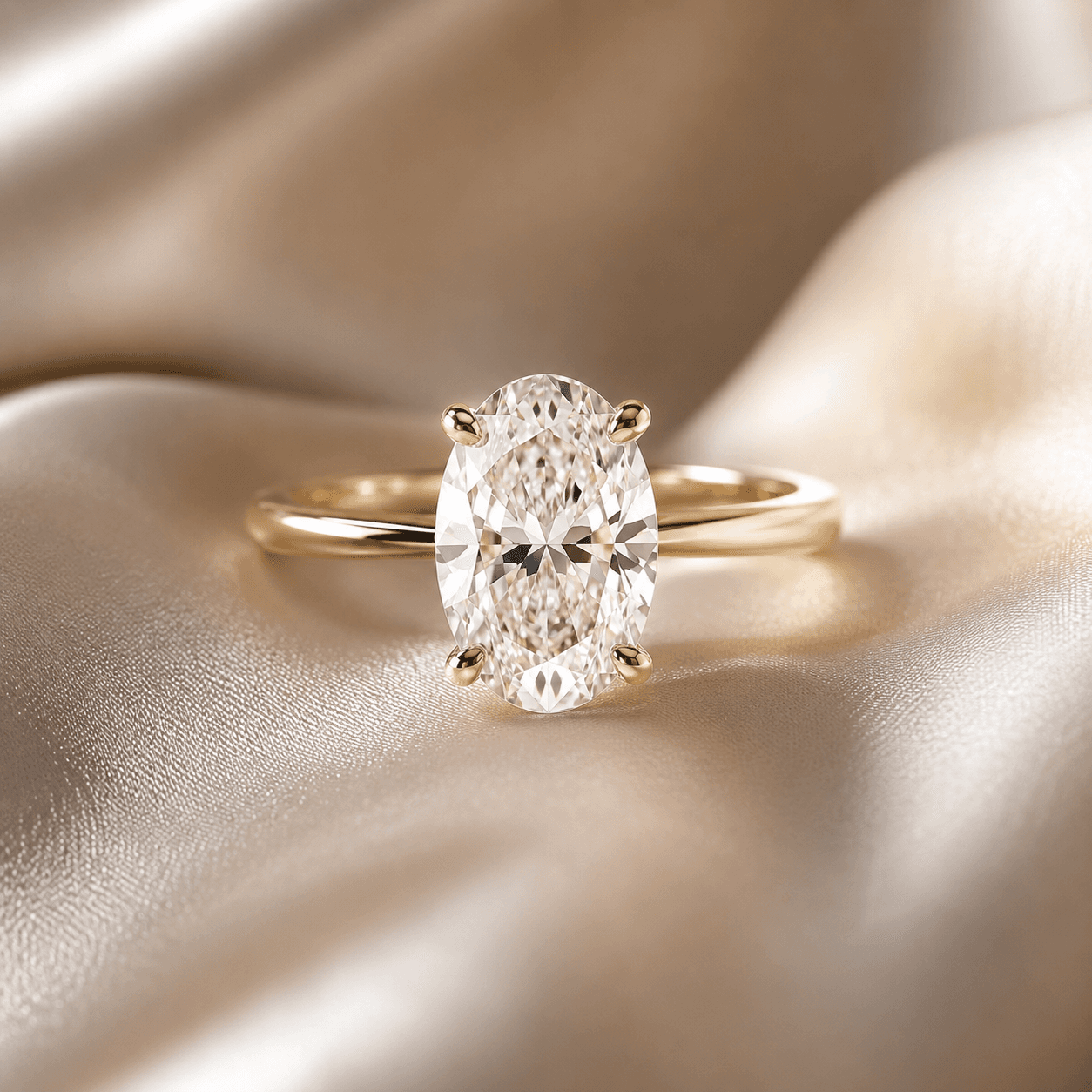
An oval cut diamond is an elongated brilliant-cut stone with 57 to 58 facets, the same light-return pattern as a round diamond stretched into an ellipse.
Key takeaways:
Best length-to-width ratio: 1.35–1.50 for the most popular, balanced look
Clarity sweet spot: VS2 or SI1 — inclusions are hard to spot at this shape
Color sweet spot: G–H for near-colorless brilliance without paying for D–F
Every oval shows some bow-tie effect; the goal is minimizing it, not eliminating it
What Is an Oval Cut Diamond?
An oval cut diamond is a fancy-shape stone cut in the brilliant faceting style, meaning light enters and exits through a pattern of triangular and kite-shaped facets rather than the step-cut facets used in emerald or Asscher shapes. The result is a stone with round-diamond sparkle in an elongated silhouette.
The modern oval brilliant was developed in 1957 by diamond cutter Lazare Kaplan, who designed a 58-facet arrangement that preserved the fire of a round brilliant while stretching the outline. The shape has three anatomical zones worth knowing before you shop:
Head (or end):
the rounded tip at either end of the stone
Shoulder:
the curved transition between the tip and the widest point
Belly:
the widest part of the diamond, where the curve is most pronounced
Symmetry matters more here than in a round diamond. Flat shoulders push the shape toward marquise; bulging shoulders push it toward a pill shape. A well-cut oval reads as a clean, even ellipse from every angle.
Oval Diamond Length-to-Width Ratio: What's Best?
The length-to-width (L/W) ratio is the single biggest factor in how an oval diamond looks, and it's calculated by dividing the stone's length by its width in millimeters.
L/W Ratio | Look | Best For |
1.20–1.29 | Shorter, rounder — close to a rounded cushion | Buyers who want oval sparkle without a strongly elongated shape |
1.30–1.40 | Gently elongated, balanced | The most versatile range, flatters most hand shapes |
1.41–1.50 | Long and slender | The most popular range for engagement rings — visually lengthens the finger |
Above 1.50 | Very narrow, dramatic | Rare; higher chance of a pronounced bow-tie effect |
There's no wrong answer here — it's a taste call. But if you're shopping and not sure where to start, 1.40–1.45 gives you the elongating effect people buy ovals for without tipping into "too skinny" territory.
Best Clarity Grade for an Oval Cut Diamond
Clarity grades measure inclusions — internal characteristics left over from the diamond's formation. For oval diamonds, VS2 or SI1 is the practical sweet spot. The brilliant facet pattern scatters light in a way that hides small inclusions well, especially near the girdle, so you're not paying a premium for clarity your eye can't actually detect face-up.
If budget isn't the deciding factor, VVS1/VVS2 or Internally Flawless stones are available and will be clean under magnification — but for a set diamond viewed at arm's length, the visual difference from VS2 is negligible.
One exception: because ovals have a large open table (the flat top facet), a stone with a dark or reflective inclusion positioned dead-center can be more noticeable than the same inclusion tucked under a girdle. This is the one case where seeing an actual video or in-person view of the stone matters more than the grade on paper.
Best Color Grade for an Oval Cut Diamond
G–H color is the practical target for most oval diamonds. Because the elongated shape concentrates color at the pointed ends, ovals can show tint slightly more than round diamonds at the same grade — so staying in the near-colorless G–H range (rather than dropping to I–J) keeps the stone looking bright rather than warm.
If you want maximum whiteness, D–F color set in white gold or platinum delivers it, at a real price premium. On the other end, J color can still look attractive set in yellow or rose gold, where the warmer metal masks the diamond's faint tint.
How to Avoid (or Minimize) the Bow-Tie Effect
Every oval diamond has some degree of bow-tie effect — a shadow that crosses the center of the stone, caused by your own head and shoulders blocking light as you view it. It's a physics problem, not a cutting defect, and it shows up in every elongated brilliant cut, not just ovals.
What separates a well-cut oval from a poorly cut one is how faint and evenly distributed that shadow is. Use this checklist before buying:
Watch the stone on video, not a static photo.
A bow-tie that looks bad in one still frame can move and lighten as the stone rotates in a well-cut diamond.
Check symmetry grade.
Excellent or Very Good symmetry correlates strongly with a softer, less blocky bow-tie.
Avoid extreme ratios.
Stones above a 1.50 L/W ratio show bow-tie more often and more sharply.
Look at the whole stone, not just the center.
A subtle bow-tie that blends into the overall sparkle pattern reads as character, not a flaw.
Oval vs. Round vs. Marquise: How They Compare
Factor | Oval | Round | Marquise |
Facet style | Brilliant (57–58 facets) | Brilliant (57–58 facets) | Brilliant, pointed ends |
Apparent size vs. carat | 5–10% larger looking | Baseline | Largest-looking per carat |
Price per carat | 20–30% less than round | Highest — most rough diamond used | Similar to or less than oval |
Shape | Elongated, no points | Symmetrical circle | Elongated, sharp points at both ends |
Durability | Rounded edges, low chip risk | Lowest chip risk | Pointed tips need protective settings |
GIA cut grade | Not assigned (fancy shape) | Assigned | Not assigned (fancy shape) |
The core difference buyers ask about: an oval has no points, so it reads softer and is more durable day-to-day. A marquise has sharp tips on both ends, which reads more dramatic but needs a protective setting — usually a V-prong — to prevent chipping.
Oval Diamond Engagement Ring Settings
The setting changes how an oval wears as much as the stone itself does.
Solitaire prong:
Classic, lets maximum light into the stone, lowest cost
Halo:
Smaller diamonds ring the center stone, boosts apparent size and brilliance
Bezel:
Metal rim fully encircles the diamond — best protection, ideal for active lifestyles
East-west:
Stone set horizontally instead of vertically, a modern styling choice
Three-stone:
Oval center flanked by two smaller stones, often half-moons or tapered baguettes
Four-prong solitaires in particular amplify the finger-lengthening effect that draws people to this shape, since there's no metal breaking the long line of the stone.
Frequently Asked Questions
What is the best length-to-width ratio for an oval diamond?
Most buyers land between 1.35 and 1.50. Ratios closer to 1.30 look rounder and more compact; ratios closer to 1.50 look longer and more slender. There's no universally "correct" number — it's a matter of which silhouette you want on your hand.
Why do oval diamonds have a bow-tie effect?
The bow-tie is a shadow cast by the viewer's own head and shoulders blocking light as they look at the stone. It appears in every elongated brilliant cut to some degree. A well-cut oval with excellent symmetry keeps the shadow faint and evenly blended rather than dark and blocky.
Is an oval diamond bigger than a round diamond of the same carat weight?
Yes. An oval's elongated shape spreads its surface area further than a round of equal carat weight, so it reads roughly 5–10% larger from above. This is one of the main reasons buyers choose oval when working within a carat budget.
What's the difference between an oval and a marquise diamond?
An oval has smooth, rounded ends with no points, while a marquise has sharp points at both ends and a more elongated, boat-like outline. The oval reads softer and resists chipping better; the marquise reads more dramatic but needs a protective prong setting at each tip.
Choosing Your Oval Diamond
The right oval comes down to three decisions: a ratio you like the look of (1.35–1.50 for most buyers), a clarity grade that's invisible face-up (VS2/SI1), and a color grade that reads bright without overpaying (G–H). Everything else — the setting, the metal, the carat weight — is personal preference layered on top of those fundamentals.
Send us an inquiry or fill out our ring builder for certified oval diamonds at Desert Wholesale Diamond and see the full 4Cs breakdown, video, and wholesale price on every stone before you buy.